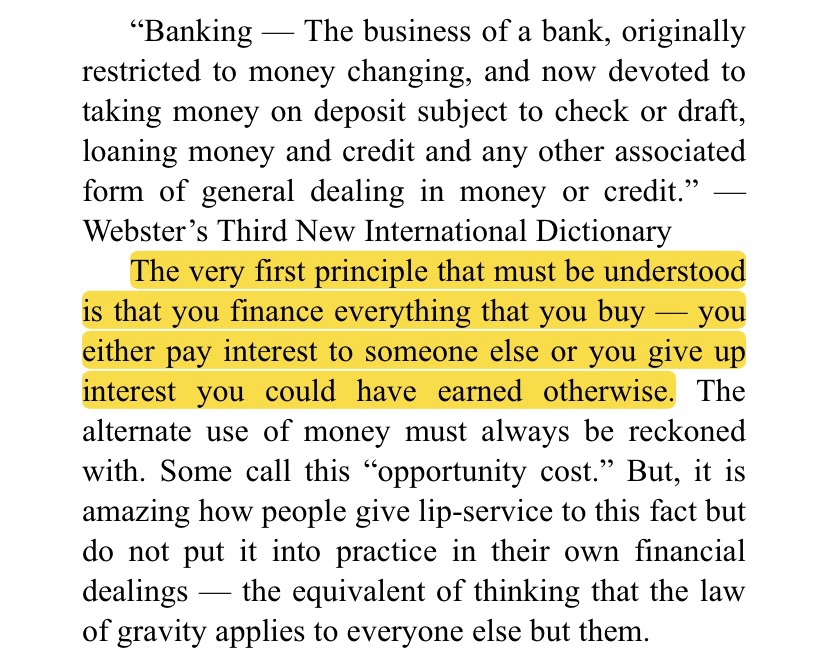
The statement above is about the future value of money. When you spend a dollar, one you have earned and not borrowed, many would say that it costs nothing but $1, but that is not true.
When you spend a dollar, you lose not only the dollar but all of the returns that dollar would bring for the rest of your life had it not been spent and been invested instead.
Since returns are not guaranteed – I like to ballpark a safe return at about 12% per year since that’s about what the S&P returns over the long term. (15 years), every invested dollar should return about 12¢ per year. At least it’s a good target, as that’s what you could earn by simply putting your money into the S&P.
Once you understand the concept above you can see the value in borrowing $1 if it costs you 5¢ per year in interest but returns 12¢ per year in value. The primary reason to avoid borrowing is the cost, but when you’re earning a net of 7¢ on money you’ve invested and subsequently borrowed back from later, there is no reason to avoid borrowing, especially if that money can be re-deployed into assets that bring additional yield.
This process of investing and using leverage wisely can be thought of as a a financial machine which allows the owner to push a button and print cash on demand from their assets.
This machine I’m describing puts dollars to work earning more dollars, provides the ability to finance new investment and spending, while protecting both savings and cash flow. It’s also tax efficient.
Many people have need for savings, but what is savings for if not for financing the things that cannot be purchased from wages or income? What if you could spend without depleting your savings, and borrow at a rate of interest which when all was accounted for was effectively negative? Borrowing money would have a cost but a negative cost, essentially it would just reduce your return, while keeping your assets protected.
You Will Not Get Rich In The Stock Market
The stock market is a casino. Trading is profitable until it isn’t and then it is expensive. The only way to play the market without spending millions for data feeds, quants, and models is for long term growth. Generating short term capital gains during times of profit and then losing most of it or even some or all of your principle during downturns only generates tax revenue for Uncle Sam. Money earned from labor is the most expensive, it provides you with capital to invest, and protecting principle with reasonable risk management is a good habit.
Any time you sell stock you will have tax on the profits. However short term capital gains are by far one of the least favorable taxation categories anyone can generate .
On the other hand, starting and running a business that is profitable is the most straightforward path to financial success.
Even flipping stuff on eBay, or creating content, or selling on Etsy or other marketplaces can generate profits that over time become significant when invested.
As an example, I flip used Citizen watches on eBay. I only buy watches I want to wear and so if they never sell, my collection grows. This is just a hobby for me, low risk and not a lot invested. Let’s say just as a hobby you could generate $200 a month in profit. Over 15 years, $200 invested monthly becomes $95,000. This is basically the cost of a nice dinner (and not that nice) once a month, a modest sum. Yet over time it becomes substantial.
When I sell a watch I usually make 20-30% return. However sometimes I make over 100% return. The stock market returns about 12% a year but I may hold a watch for a few weeks in comparison, which allows the money to compound even faster.
I use my credit line from my portfolio to buy watches, and when it sells, I put the money back into my account and use the profit to buy more S&P 500.
Tax Free Growth You Can Use (In an Account That’s Not Tax Privileged).
Once you understand that you can generate a return on money, and that it doesn’t matter if it’s earned money or borrowed money, you also will be able to understand that debt exists in a category separate from income for tax purposes.
When you borrow against shares of the S&P 500 that have appreciated in value, you are able to borrow the unrealized portion of the return. This means you have taken theoretical profits you haven’t even realized yet and collateralized them without having to realize the profit from the sale.
This allows you to spend money you haven’t earned and which cannot be taxed. If your tax rate is 25%, it’s like getting 25% more purchasing power from your wealth.
A lot of people understand the importance of tax free growth from a 401k or an IRA, but you can get tax free growth by creating debt, and that allows you to use your money while continuing to hold on to your assets, continuing to collect appreciation and dividends.
When you create tax free returns inside of a Roth you cannot use that money until you retire, except under hardship.
Intelligent investors understand the value of debt and while unsophisticated consumers simply don’t. They think debt is bad, or get into debt buying experiences instead of assets.
To build this economic engine you need income, a portfolio with an SBLOC (Securities Backed Line of Credit), and ideally assets that cash flow.
I use Robinhood, but Public is another option to use to build this kind of engine.
The Process Defined:
1: Buy shares in an etf you will never have to sell. I’ve selected the S&P 500, I buy VOO.
2: Invest as much as you feasibly can into the S&P, knowing that the purpose of this portfolio is to build a line of credit, it is not for retirement, retirement savings should be managed separately and without margin risk.
3: Borrow sparingly from this portfolio. Ideal uses are to buy assets that aren’t in the S&P 500 such as physical metals, real estate, or to start a business.
4: You must understand margin lending and that reserve requirements may change in volatile times. It is safe to assume that the S&P may drop rapidly by 20-30%, so it is advisable to not borrow more than 30-40% of the value of the portfolio.
5: Margin debt has no due date, no minimum payment, no amortization schedule. Therefore the debt never has to be repaid in full while the owner is alive. The goal is not to be debt free but to accumulate as much low rate debt backed by the S&P as possible while using the borrowed money to buy cash producing assets which can be fed back into the engine and used to buy even more S&P 500. Eventually you’ll reach a point where the cash coming in is so much greater than the need to borrow that you will reach escape velocity. You can simply choose to live off of a portion of the cash flow from your other assets and use the growth in the S&P alone to purchase larger investments or to finance your lifestyle.
6: As stated – margin loans are not taxed as income, and even when you pass the shares to your heirs they will get a step up basis for tax purposes with proper estate planning.
Risks
Markets fluctuate sometimes violently. This strategy is not without it’s risks, however if you use borrowed money to buy inventory, physical metals, to start a business, or to buy real estate, if markets implode you still have your other assets.
This is why I avoid using margin to go deeper into equities and instead prefer to use the SBLOC (Securities Backed Line of Credit) to fund activities outside of the equities market.